One-Line Definition
Blood Relations is the study of relationships between people based on family connections such as parent, child, sibling, spouse, grandparent, uncle, aunt, and cousin.
Words → Structure → Relationship
The universal golden rule of Blood Relations:
- • 1. Words: Break dense English sentences into atomic relations.
- • 2. Structure: Map people onto generational levels (+2, +1, 0, -1).
- • 3. Relationship: Read the requested connection in the exact direction.
The difficulty in Blood Relations is almost never knowing individual terms like "mother", "uncle", or "brother". The true challenge is connecting multiple relationships without losing track of the family structure, confusing generational levels, or introducing unsupported assumptions.
Consider This Typical Puzzle Setup:
- • Clue 1: A is the brother of B.
- • Clue 2: B is the mother of C.
- • Clue 3: D is the father of A.
Question: How is D related to C?
Without a structural map: Students attempt to juggle all four names in their head, often guessing "Father" or guessing "Grandfather" without identifying whether it is paternal or maternal, or accidentally answering who C is to D.
With a structural map:
- From Clue 1: A and B are siblings sharing the same parents.
- From Clue 3: D is the father of A → D is therefore also the father of B.
- From Clue 2: B is the mother of C → D is the father of C's mother.
Where Is It Used?
- MAH MBA CET: 4 to 6 direct questions per slot (dialogues, coded equations, and 3-question mini-sets). Speed target: under 45 seconds.
- SNAP & NMAT: 2 to 4 rapid speed-based questions where generation gap scoring eliminates incorrect options instantly.
- CAT & XAT: Embedded as the core constraint in complex 4-5 question DILR sets (e.g., circular seating arrangements with family relationship conditions).
Prerequisites
- • Family Lineage Knowledge: Understanding Paternal (Father's side) versus Maternal (Mother's side) relationship terms.
- • Generational Awareness: Recognizing relative generation gaps (+2 Grandparents down to -2 Grandchildren).
- • Zero Assumption on Gender: Awareness that names (e.g., Kiran, Sonu, Robin) never establish gender in entrance tests.
- • Clause Parsing: Comfort decomposing nested possessive sentences (e.g., "wife of the brother of my father").
Master these seven foundational principles to solve any Blood Relations puzzle with zero ambiguity:
Strict Gender Neutrality
Gender is only established when explicitly stated (e.g., "male", "sister", "mother", "son") or logically deduced (e.g., in a married heterosexual couple where one is the wife, the other is the husband). Never infer gender from names.
Generation Level Hierarchy
Always organize family members vertically by generation tier: +2 (Grandparents), +1 (Parents, Uncles, Aunts), 0 (Self, Siblings, Cousins, Spouse), -1 (Children, Nephews, Nieces), -2 (Grandchildren).
Direct vs Indirect Relations
Direct relations share immediate genetic or matrimonial links (parent-child, sibling, spouse). Indirect relations are connected via intermediate bridge nodes (in-laws, cousins, uncles). Always build from direct links outwards.
Reading the Direction Accurately
"How is X related to Y?" means: "What is X with respect to Y?" If X is Y's uncle, then Y is X's nephew/niece. Answering "Nephew" when asked "How is X related to Y?" is the #1 reason students lose marks.
Generation Levels & Standard Symbol Notation
Standard Notation SystemUse this standardized notation system when drafting scratch-sheet diagrams during timed CAT and CET exams:
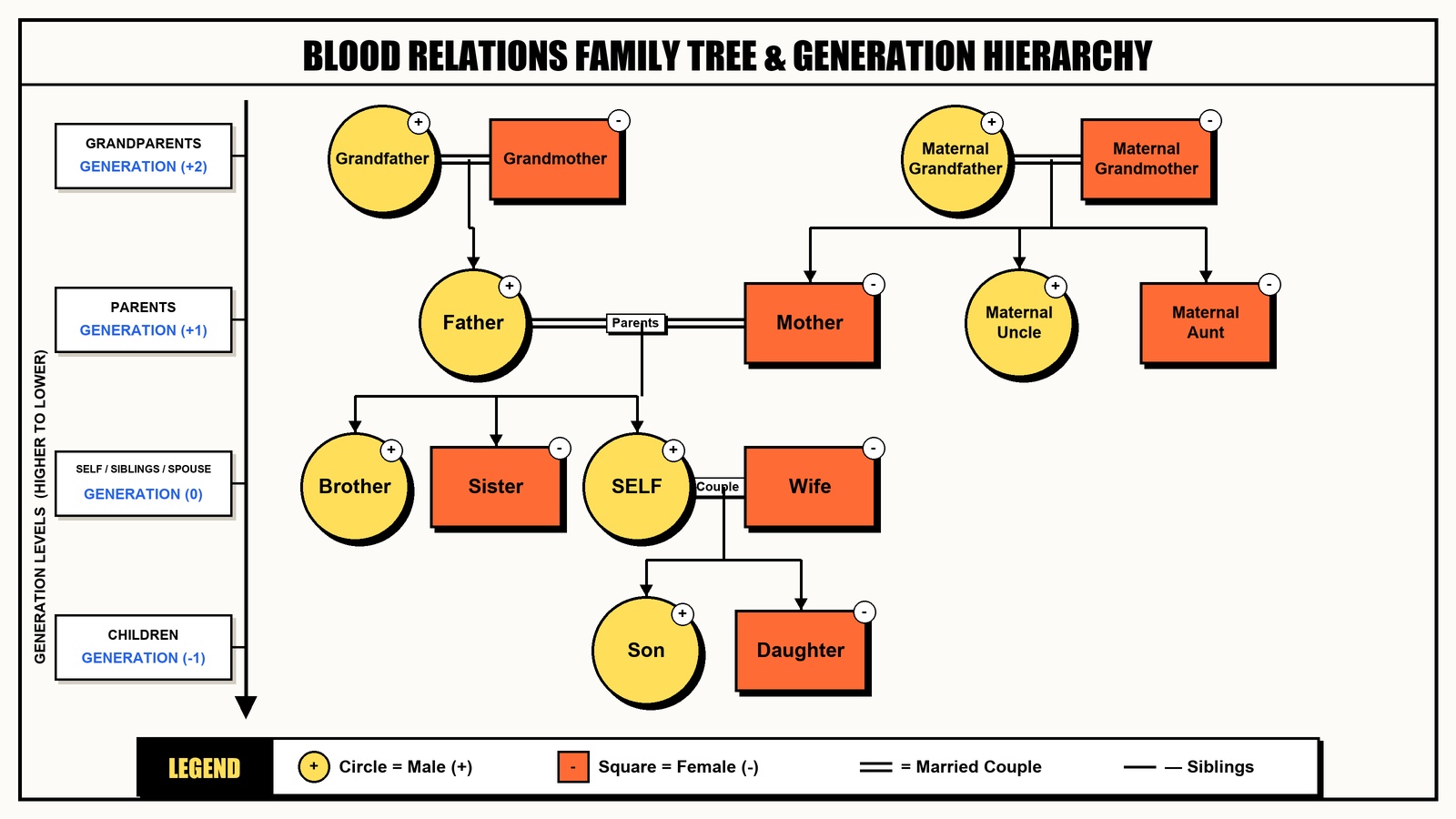
Quick Reference: Relational Deductions
| Expression / Clue | Deduction | Generation Gap |
|---|---|---|
| Father's brother OR Mother's brother | Paternal Uncle / Maternal Uncle | +1 |
| Father's sister OR Mother's sister | Paternal Aunt / Maternal Aunt | +1 |
| Brother's son OR Sister's son | Nephew (Male) | -1 |
| Brother's daughter OR Sister's daughter | Niece (Female) | -1 |
| Child of Uncle or Aunt (any gender) | Cousin | 0 |
| Spouse's brother OR Sister's husband | Brother-in-law | 0 |
| Spouse's father / Spouse's mother | Father-in-law / Mother-in-law | +1 |
Follow this exact 7-step sequence on every Blood Relations problem to avoid traps and save precious minutes:
Identify All Relevant People
Scan the passage and enumerate the distinct entities (e.g., A, B, C, D, or the speaker and photograph person).
Find the Direct Relationships
Isolate the absolute statements that connect two individuals directly (e.g., "A is married to B", "C is the mother of D").
Draw or Extend the Family Structure
Place each person onto the appropriate generation tier. Use vertical lines for parent-child descents and horizontal lines for same-generation links.
Mark Gender Where Known
Tag [+] for Male and [-] for Female only when strictly established. Leave nodes neutral if gender has not yet been specified.
Connect the People Named in the Question
Merge disjoint sub-trees using common anchor persons (e.g., common siblings, common in-laws, or marriage links).
Trace the Relationship in the Requested Direction
Start from the reference person ("with respect to Y") and look up/across/down to the target person ("X is..."). Do not invert the question.
Check Whether the Conclusion Relies on Unsupported Assumptions
Confirm that gender was not assumed, multiple marital partners were not invented, and that the answer is not ambiguously "Either Brother or Sister".
SOLVED EXAMPLES (LEVEL 0 TO EXAM HARD)
Q: Pointing to a photograph of a boy, Priya says, "He is the son of the only daughter of my paternal grandfather." How is the boy in the photograph related to Priya?
Step 1 (Reference Person): Priya is the speaker.
Step 2 (Paternal Grandfather): "My paternal grandfather" = Priya's father's father (Generation Level +2, Male).
Step 3 (Only Daughter): The paternal grandfather's daughter is the sister of Priya's father = Priya's Paternal Aunt (Bua) (Generation Level +1, Female).
Step 4 (Son): "He is the son of [Priya's Paternal Aunt]" = Priya's Aunt's son (Generation Level 0, Male).
Step 5 (Structural Representation):
• Level +2: Paternal Grandfather [Male]
• Level +1: Priya's Father [Male] ── Paternal Aunt [Female]
• Level 0: Priya [Gender unstated] ── Boy in Photo [Male] (Children of siblings = Cousins).
Q: A is the father of B and C. B is married to D. E is the mother of D. F is the brother of C. G is the son of B. How is E related to G?
Step 1: A (Level +2, Male) is the father of B, C, and F (since F is the brother of C).
Step 2: B (Level +1, Male/Female) is married to D (B = D). Since G is the son of B, G is the child of both B and D (Level 0, Male).
Step 3: E is the mother of D (Level +2, Female). Therefore, D is the daughter of E.
Step 4: Because G's mother is D (or father is D, but E is parent of D), E is the parent of G's parent.
Step 5: Specifically, D is the mother of G, and E is the mother of D. Hence, E is the mother of G's mother.
Step 6 (Structural Representation):
• Level +2: A [Male] | E [Female, Mother of D]
• Level +1: B [Father] = D [Mother, Daughter of E]
• Level 0: G [Son]
Q: In a family of seven members—P, Q, R, S, T, U, and V: P is married to Q, who is the mother of R. S is the brother of P. T is the daughter of R. U is the sibling of T. V is the father-in-law of S. How is U related to P?
Step 1 (Generation +1): Q is the mother of R → Q is Female [-]. P is married to Q → P is Male [+] (Father of R).
Step 2 (Generation 0): R is the child of P and Q. (Note: R's gender is unstated).
Step 3 (Generation -1): T is the daughter of R → T is Female [-] (Granddaughter of P and Q).
Step 4 (Target Person U): U is the sibling of T. Since T is R's child, U is also R's child. Thus, U is the grandchild of P.
Step 5 (Critical Exam Check — Gender Constraint): Is U's gender explicitly given?
• Statement says: "U is the sibling of T."
• Sibling can be either a brother or a sister.
• No other clue defines U's gender. Therefore, U could be either a Grandson or a Granddaughter.
Mistake 1
Solving Long Chains in Your Head
Attempting to parse "the sister of the father of my son's brother" purely in working memory leads to inversion. Always scribble a 5-second diagram on scratch paper.
Mistake 2
Reversing the Requested Relationship
If X is the uncle of Y, students often select "Nephew" because they read from X to Y backwards. Always answer: "What is X to Y?"
Mistake 3
Assuming Gender from Names
In Indian MBA tests, names like "Kiran", "Kamal", "Sonu", or "Deepak" carry zero gender presumption. Never assign [+] or [-] unless justified by relation terms.
Mistake 4
Confusing Siblings with Spouses
Using single dashes for both couples and siblings leads to disastrous errors in puzzle sets. Always reserve double line [=] strictly for marriages and single line [-] for siblings.
Mistake 5
Losing Track of Generation Floors
Placing brother-in-law on generation +1 instead of generation 0, or mixing nephew (-1) with uncle (+1), breaks entire constraint networks.
Mistake 6
"Only Son" vs "Only Child"
An "only son" may have 3 sisters! An "only child" has zero siblings of either gender. Never assume "only son" means no siblings exist.
CAT & MBA CET SPEED SHORTCUTS
The Gender Filter Shortcut
In coded blood relations (e.g., P + Q × R - S), check the operator immediately following the target entity. If P must be the uncle (Male), but P - Q means P is the sister (Female), eliminate that entire option in 2 seconds without solving!
The Generation Gap Score
Assign numerical values to operators: Father/Mother = +1, Son/Daughter = -1, Brother/Sister/Spouse = 0. If the question asks for "Grandfather" (target gap = +2), any option whose algebraic sum is +1, 0, or -1 is mathematically impossible.
Reverse Parsing (Right-to-Left Rule)
In pointing problems, e.g., "He is the son of the wife of the only brother of my father":
1. "my father" → Father
2. "only brother of my father" → Paternal Uncle
3. "wife of [Uncle]" → Paternal Aunt
4. "son of [Aunt]" → Cousin!
Family Tree as an Offloading Tool
Never treat sketching as additional work. Drawing simple lines and boxes takes 4 seconds, but saves 45 seconds of re-reading confusion. Don't make it pretty—make it structurally unambiguous.
CAT & XAT (DILR Sets)
CAT never asks standalone 1-mark blood relation questions. Instead, family trees form the hidden constraints in 4-question seating or matrix arrangement sets. Top scorer rule: Complete the family tree first before touching the seating grid!
MAH MBA CET
CET features 4 to 6 direct and coded blood relation questions per slot. Since CET is a pure speed-accuracy race (200 questions in 150 minutes), Top scorer rule: Use the Gender Filter and Generation Score shortcuts to answer in 20-30 seconds each.
SNAP & NMAT
SNAP and NMAT focus heavily on pointing/photograph statements and 2-generation family puzzles. Top scorer rule: Use reverse right-to-left parsing from "my" to avoid re-reading the question multiple times.
Test your understanding with these carefully calibrated questions. Try solving them on scratch paper before revealing the worked solutions.
Pointing to a man, a woman said, "His mother is the only daughter of my father." How is the woman related to the man?
Solution:
1. Start with "my father" → Woman's father.
2. "Only daughter of my father" → Since the speaker is a woman, the only daughter of her father is the woman herself!
3. "His mother is [myself]" → The man's mother is the woman.
Answer: Mother
A is the sister of B. B is the daughter of C. D is the father of C. How is A related to D?
Solution:
1. A is the sister of B → A is Female [-]. A and B are on the same generation tier.
2. B is the daughter of C → Both A and B are daughters of C.
3. D is the father of C → D is one generation above C, and two generations above A and B.
4. Trace A relative to D: A is the daughter of D's child (C). Since A is female, A is D's granddaughter.
Answer: Granddaughter
Ravi is the brother-in-law of Priya, who is the sister of Amit. Amit has no brothers, and Priya is unmarried. How is Ravi related to Priya's sister?
Solution:
1. Priya is unmarried and is the sister of Amit.
2. Ravi is Priya's brother-in-law. A brother-in-law can be either a sister's husband or a spouse's brother.
3. Since Priya is unmarried, Ravi cannot be her husband's brother. Ravi must be married to Priya's sister.
4. Therefore, Ravi is the husband of Priya's sister.
Answer: Husband
Examine the coded relations:
• P × Q means P is the father of Q
• P + Q means P is the sister of Q
• P - Q means P is the brother of Q
• P ÷ Q means P is the mother of Q
In the expression M ÷ K - L + T × W, how is M related to T?
Solution:
1. M ÷ K: M is the mother of K (Generation +1, Female).
2. K - L: K is the brother of L (Same Generation 0, Male).
3. L + T: L is the sister of T (Same Generation 0, Female).
4. Since K, L, and T are all siblings sharing the same mother, M is the mother of all three!
5. Therefore, M is the mother of T.
Answer: Mother
In a family of eight members (A through H): A and B are a married couple; A is male. C is the only brother of A. D is the father-in-law of B. E is the son of C. F is the sister of E. G is the mother-in-law of C. H is the daughter of A. How is F related to D, and how is H related to C?
Solution:
1. Couple: A [Male] = B [Female]. Daughter of A and B is H [Female].
2. C is the brother of A. So A and C are brothers.
3. D is the father-in-law of B → D is the father of A (and consequently the father of C as well).
4. E is the son of C, and F is the sister of E → F is the daughter of C.
5. How is F related to D? F is the daughter of C (D's son) → F is the Granddaughter of D.
6. How is H related to C? H is the daughter of A (C's brother) → H is the Niece of C.
Answer: F is the Granddaughter of D; H is the Niece of C
FREQUENTLY ASKED QUESTIONS
❓ Can we assume gender based on names in Blood Relation questions?
Never assume gender based on names (e.g., Kiran, Robin, Alex, Priya). Gender must strictly be deduced from explicit relation terms like 'father', 'sister', 'son', or given gender statements. If gender remains undetermined, choose "Cannot be determined".
❓ What is the exact difference between "only son" and "only child"?
"Only son" means a person has only one male offspring, but may have multiple daughters. "Only child" means a person has zero other siblings of either gender. This distinction frequently appears in tricky exam questions.
❓ How does the Generation Gap method work for Coded Blood Relations?
By assigning numeric values (Parents/Aunts = +1, Children = -1, Siblings/Spouse = 0), you sum the values across the coded chain. If the question asks for Grandfather (+2), any option yielding a net sum of 0 or +1 is immediately discarded.
❓ How do I handle questions where the gender of the last person is not specified?
If a person's gender is neither stated nor implied through marriage or parental constraints, you cannot conclude a gender-specific relation. The answer must be 'Cannot be determined' or an ambiguous option like 'Brother or Sister'.
❓ What is the fastest way to solve "pointing to a photograph" questions?
Use the reverse parsing method: locate the word "my" or "his/her", trace the relationships backwards step-by-step to the speaker, and then connect to the subject in the photograph. This eliminates confusing forward mental leaps.
Expand your mastery across the complete Blood Relations curriculum: